

A collection of longer documents about the dairy industry, useful for research or more in-depth study. Listed by year of publication, where known, oldest at the top.
Click each image to view or download the file
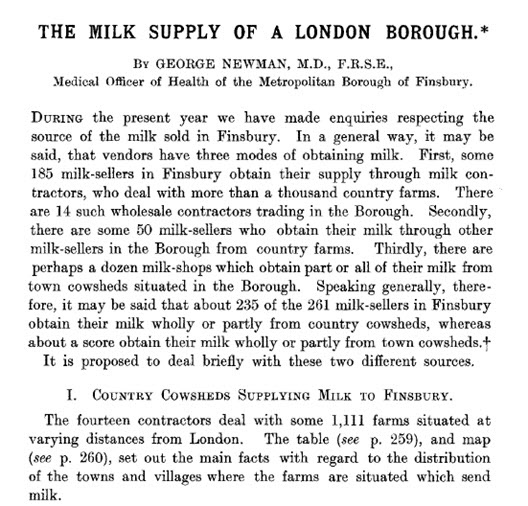
This 1903 report by George Newman M.D. F.R.S.E., Medical Officer of Health in Finsbury (now in the London Borough of Islington) describes how most of the milk sold in the Borough came from roughly 1,200 country farms—mainly in Derbyshire, Staffordshire, Leicestershire, and Wiltshire—after long, poorly regulated journeys by rail and through multiple middlemen. This made the milk 12–24 hours old and difficult to trace for contamination or disease. Inspections from several counties revealed widespread problems in rural cowsheds, including overcrowding, poor ventilation, filth, and the presence of tuberculosis in cows, some of whose milk was diverted to London when rejected elsewhere. By contrast, Finsbury’s own small number of urban cowsheds were better regulated, though not always perfectly clean.

Extracts from an article published in the August 2012 edition of 'THE LOCAL HISTORIAN' (Journal of the British Association for Local History) based on farming stories published in the period 1910 - 1915 and analysed by Roger Dalton, when he was Honorary Visiting Fellow at the University of Derby.
Discussed in detail are the dairy breeds during this period, the transport of Derbyshire milk by rail to London., and to local creameries at Egginton, Sudbury, Uttoxeter, Castle Donington, Hatton and Ashbourne. Milk was also sent for cheesemaking at Brailsford, Gratton, Hartington and Parwich.

1930's paper by T.J. Drakeley (British Dairy Farmers' Association), assisted by Walter Nell and others, discusses the variety of vessels used for the transport of milk, from churns to cream jars.

This 1939 edition of the Journal of the British Dairy Farmers Association has 356 fascinating pages, with sections describing a dairy tour of Finland, dairying in the South West of Scotland, Preparation of dairy by-products, Fat Content of Cheese, Containers for milk and the 1938 Dairy Show.
Also included is a full list of dairy farm members and examination results, useful for those doing family research.

The Milk and Dairies (General) Regulations 1959, which came into force in England and Wales on 8th March set mandatory hygiene standards for farms, dairies, and milk handling. They included provisions for registration of dairy farms and dairies, cattle inspection, buildings, storage and handling of milk, cleaning plant and distribution. The regulations applied until 1995, when they were superseded, see below.
A complete version of Bryan Morgan's 1964 book written for Express Dairy's centenary. Also including a number of illustrations, the book covers the Barham family up to 1864, George Barham (1864-1913), Titus Barham (1913-1937), Walter Nell (1937-1960) and William Bell (1960 onwards).

This is an extract, produced by Express Dairy Tales, of a 1975 European Commission Report 'A STUDY OF THE EVOLUTION OF CONCENTRATION IN THE FOOD INDUSTRY FOR THE UNITED KINGDOM'. The extract only includes those specific references to Express Dairy in the 241 page report.

This paper was published by P.J. Atkins in 1977 (Department of Geography, University of Leicester). It covers the period 1790 to 1914; until the 1870s London's milk supply was produced largely within the city, due partly due to cowsheds in the expanding built-up area. The paper explains that new urban locations, some distance from the traditional pastures, were also sought by cow keepers wishing to be closer to their market. The development of large-scale production was disrupted in the 1840s by cattle disease, and in the second half of the century the trade was afflicted by several additional adverse factors which undermined its profitability. Also contains many interesting tables and references.
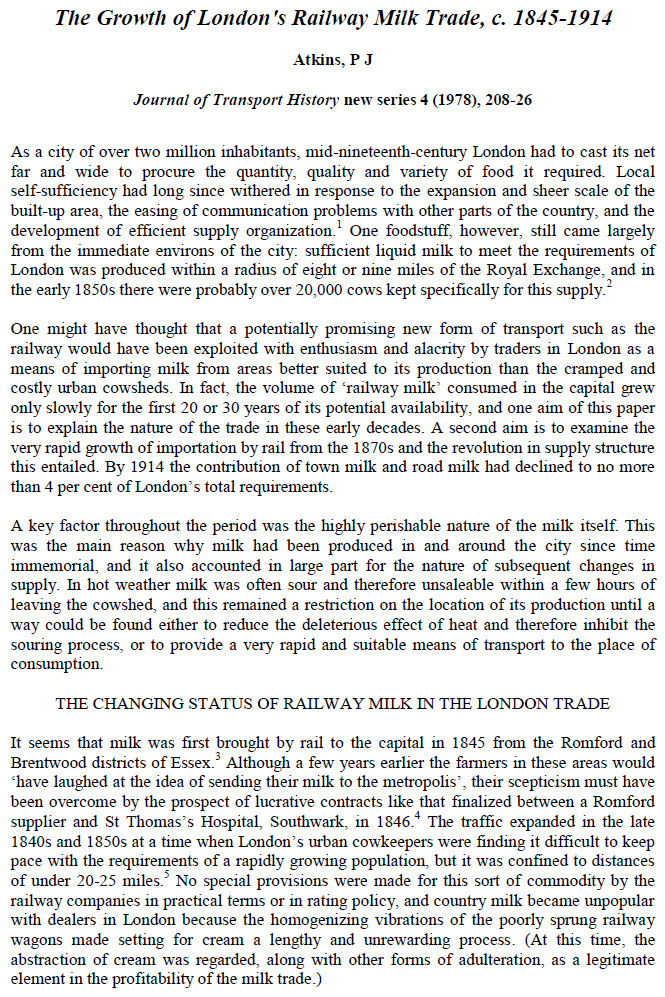
The Growth of London's Railway Milk Trade, c. 1845-1914 was written and published by P.J. Atkins in the Journal of Transport History in 1978. It includes detailed information on the railway companies involved, the volumes of milk carried and the areas that the milk was carried from.
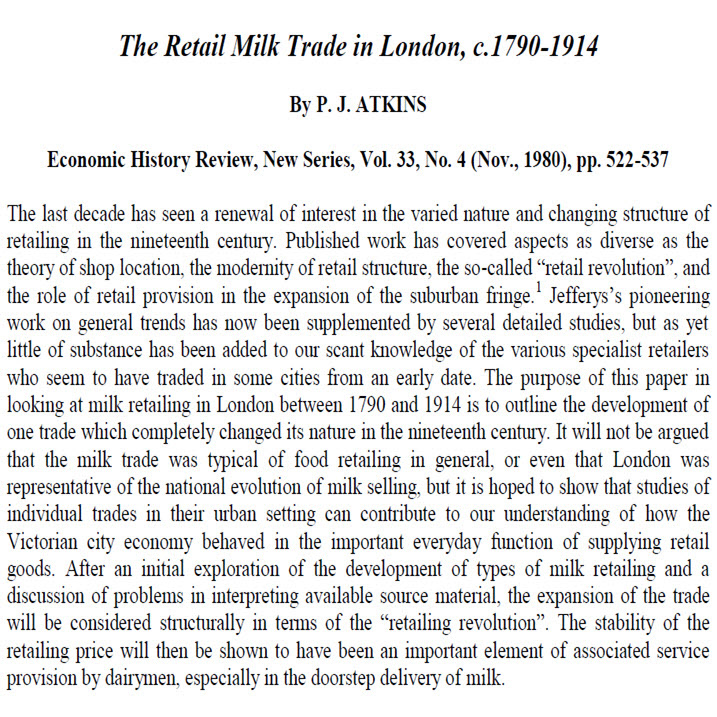
The Retail Milk Trade in London covers the period 1790 to 1914, and was published in the Economic History Review in November 1980, written by P.J. Atkins. Detailed statistics are provided about the number of cowkeepers and dairymen throughout the period, when it seemed that milk prices remained relatively unchanged.
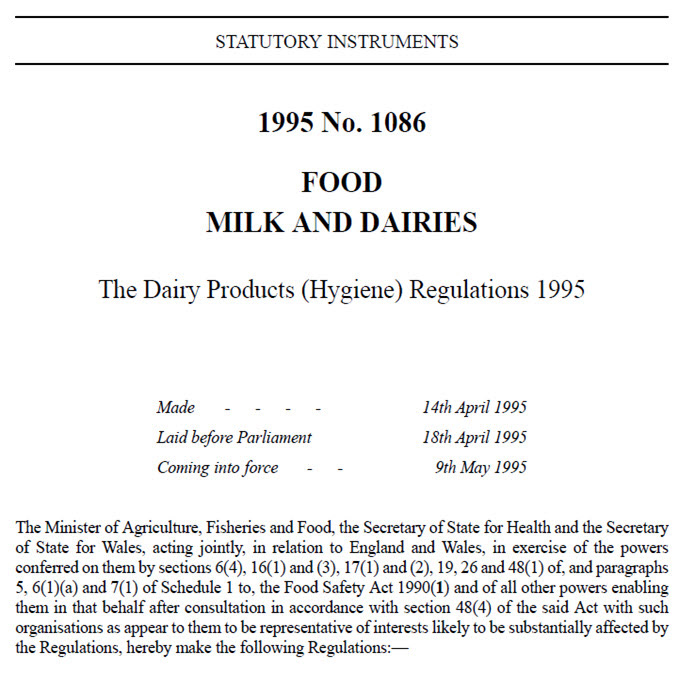
The Dairy Products (Hygiene) Regulations 1995, which came into force in England and Wales on 9th May, set mandatory hygiene standards for farms, dairies, and milk handling. They regulate raw milk quality, require heat treatment (e.g., pasteurization) for most milk sales, and ensure proper staff training, equipment hygiene, and disease control.
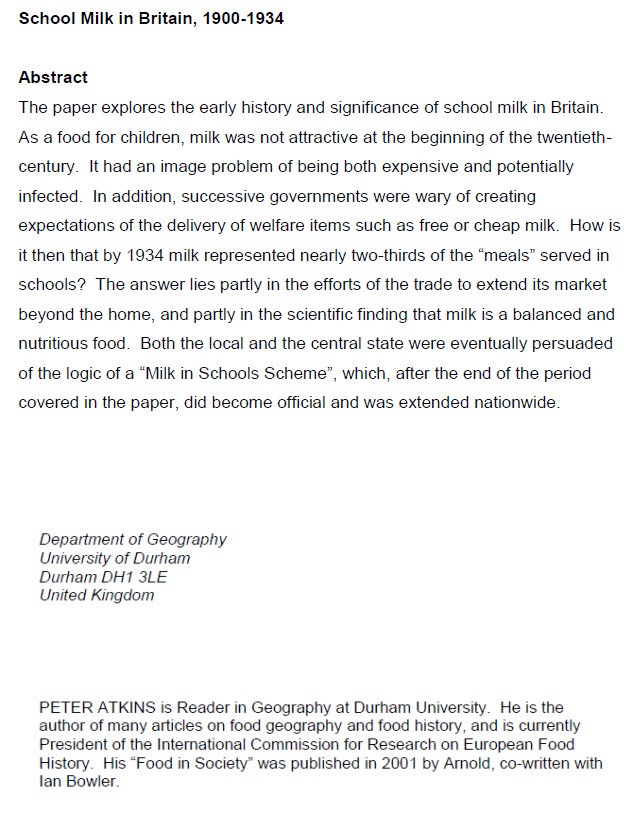
School Milk in Britain, 1900-1934 was published in 2007 by Peter J. Atkins, Department of Geography, University of Durham. His paper explores the early history and significance of school milk in Britain. As a food for children, milk was not attractive at the beginning of the twentieth-century because it was thought to be both expensive and potentially infected. Successive governments were wary of creating expectations of the delivery of welfare items such as free or cheap milk, but by 1934 milk represented nearly two-thirds of the “meals” served in schools? The answer lies partly in the efforts of the trade to extend its market beyond the home, and partly in the scientific finding that milk is a balanced and nutritious food.

This paper by Peter J. Atkins, published in Historia Agraria in 2017, traces how the idea of “quality” in British drinking milk has evolved from the mid‑19th century to today. It explains how early concerns centred on adulteration, contamination, and the dangers of diseases like bovine tuberculosis, leading to scientific testing, legal standards, and eventually widespread pasteurization. Through the 20th century, milk quality became shaped by industrial organization, long‑distance transport, new technologies, cattle breeding that altered milk composition, and growing government regulation. In recent decades, health concerns, antibiotic residues, and market segmentation (such as low‑fat or fortified milks) have further transformed what consumers expect from milk. Overall, modern milk is presented as the product of a long, layered history of science, law, technology, and shifting cultural ideas about purity, safety, and value.
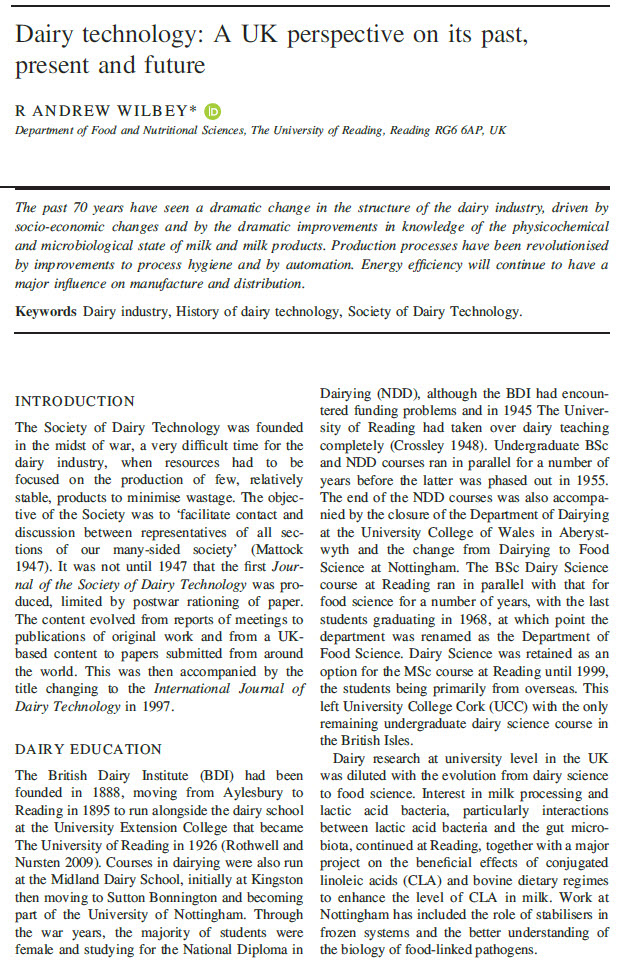
Dairy technology: A UK perspective on its past, present and future by Andrew Wilbey, © 2017 Society of Dairy Technology.
Abstract - The past 70 years have seen a dramatic change in the structure of the dairy industry, driven by socio-economic changes and by the dramatic improvements in knowledge of the physicochemical and microbiological state of milk and milk products. Production processes have been revolutionised by improvements to process hygiene and by automation. Energy efficiency will continue to have a major influence on manufacture and distribution.
Abstract - The past 70 years have seen a dramatic change in the structure of the dairy industry, driven by socio-economic changes and by the dramatic improvements in knowledge of the physicochemical and microbiological state of milk and milk products. Production processes have been revolutionised by improvements to process hygiene and by automation. Energy efficiency will continue to have a major influence on manufacture and distribution.
The Society of Dairy Technology published Nigel White's book in 2018. It covers the complete history of cheesemaking in the UK from Roman times, Medieval Britain, the Corn Laws and the industrial revolution. Cheese varieties are listed and production statistics quoted, and the book goes on to cover the two world wars, the creation of the Milk Marketing Boards, 1960s expansion, the EEC and onwards to the 21st Century. A wide-ranging and fascinating account.
This 2022 article by Chris Otter, Professor of History at Ohio State University analyses the formation of the logistical system designed to supply and deliver milk in twentieth-century Britain. The article explores several themes: the monotonous lives of cattle; the relations forged by milkmen; and the acceleration of milk distribution. This is a scholarly article analysing the liquid milk industry from a different viewpoint. It also includes some interesting photographs and many interesting references.

This 2023 presentation to the Rural Museums Network outlines Peter Roper’s Express Dairy Tales project, a large‑scale personal archive dedicated to preserving the history of Express Dairy and related companies. After retiring in 2021, he began digitising decades of magazines, photos, and documents, building a website and a fast‑growing Facebook community that now contributes additional material. He describes the hardware and software used for high‑quality scanning, the challenges of image quality, attribution, and restoration, and his efforts to create coherent publications from fragmented historical sources. The project involves extensive travel, networking, and daily work, alongside notable ongoing costs, and he raises the long‑term question of how to preserve the digital archive for future access.
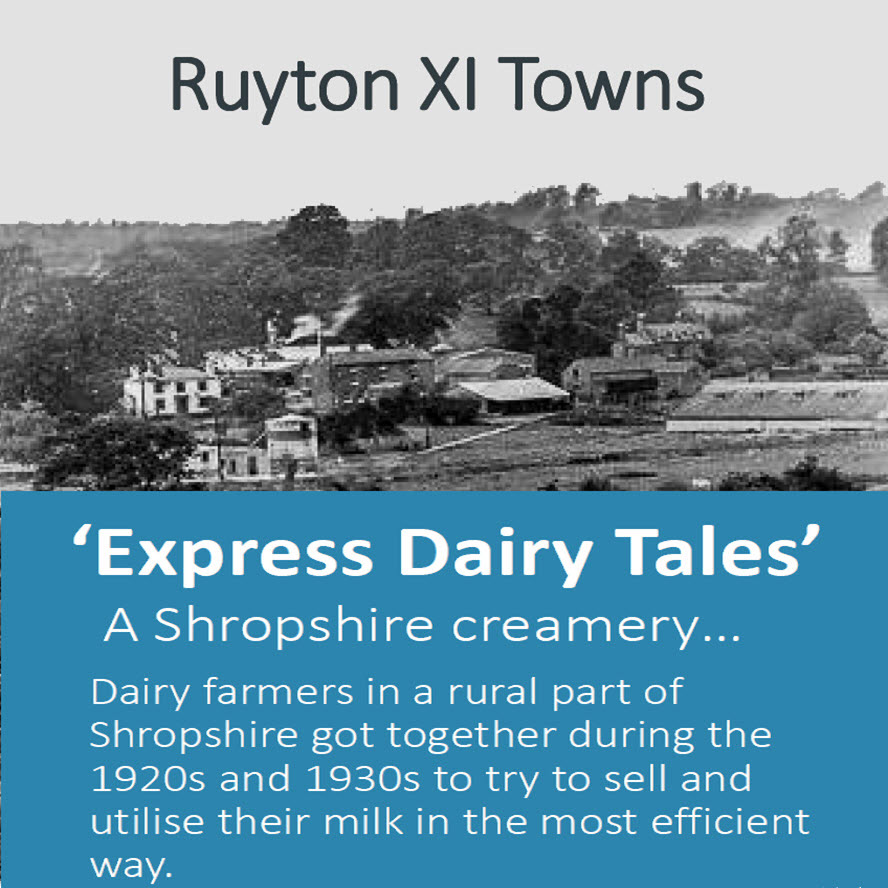
This 2025 presentation to the Rural Museums Network outlines Peter Roper’s Express Dairy Tales project to document some of the history of the creamery at Ruyton XI Towns, Shropshire. It was started as a farmers co-operative at Hall Farm, Ruyton in 1918 with the aim of providing Cheshire cheese making facilities for local farms as a profitable outlet for their milk. Scans of documents from the farm illustrate some of the difficulties experienced during the 1920s and 1930s, a time of national financial recession. After the MMB was formed in 1933, the creamery was sold to Kraft Foods, and in 1954 it was again sold to Express Dairy, who ran it until closure in 1993.

An illustrated article written by Peter Roper in 2026 for the British Agricultural History Society's newsletter 'Rural History Today'. It describes the history of Express Dairy from 1864 to 1964, when the Company celebrated its centenary.